


Visitors are welcome. Getting the right people to return is better. A lead magnet to grow your audience can bridge that gap by offering practical help and starting a relationship that does not depend solely on the next algorithm change. But giving away a file is not enough. The resource, landing page and follow-up messages must deliver on the same promise, without turning a download into a sales trap.
1. What is a lead magnet and what should it achieve
It is a resource that you provide in exchange for contact information, usually an email. It can be an important gateway to attract qualified contacts, although it is not the only one. Its value is in attracting people with a problem related to your service. An email address does not automatically equate to commercial interest nor does it turn the downloader into a customer.
2. Reduce fear of spam clearly
Before requesting information, explain what the person will receive, how they will arrive, and what communications they can choose later. Show a helpful preview and avoid absolute promises like “zero hassle.” Separate the requested delivery from permission to receive promotions. The AEPD guidance on unwanted advertising reminds us of the importance of consent and being able to withdraw it. Trust grows when there is an understandable choice.
3. Choose a format that makes it easy to act
A template saves repetitive work; a checklist reduces forgetfulness; a brief guide clarifies a decision. A mini-course is useful when you need to practice in stages and a calculator helps you explore scenarios with visible assumptions. A free trial allows you to evaluate a service, as long as it explains duration, limits and possible subsequent costs. The best format depends on the task, not which looks more spectacular.

4. Solve a specific and immediate problem
“Complete guide to improving your company” promises too much and provides little guidance. “Checklist to review your profile before launching a campaign” identifies a situation and an achievable result. Prioritize a small victory that can be applied soon, without requiring another purchase to understand the resource. The more precise the problem, the easier it will be to recognize who you are helping.
- Collect frequently asked questions and choose one that appears near your main service.
- Defines what the person will be able to complete and what materials they will need to do it.
- Create a first version and test it with people of the profile you want to reach.
5. Design a landing page that delivers on the promise
The capture page needs a concrete headline, a brief explanation, a sample of the resource, and a recognizable call to action. Only ask for the necessary information and check the route from your mobile. The W3C accessible forms tutorial recommends simple forms, clear labels, and understandable instructions. Reducing friction does not mean hiding conditions or using confusing boxes to get more registrations.
6. Connect the download with a useful welcome
The delivery email should facilitate access and explain where to start. Later, when permission exists for that communication, a welcome sequence can accompany the application of the resource. That is nurturing the relationship: adding context and resolving doubts, not chasing a sale in each message. Adjust the pace to what you have announced and allow you to easily stop receiving communications.
A simple sequence to get started
- Deliver the resource and verify that the link works without unnecessary steps.
- Share an example of use and ask what difficulty has arisen when applying it.
- Propose related content or a conversation when it makes sense, without pressuring.

7. Attract the right profile and segment wisely
The resource also filters. A template for restaurants interests a different audience than a calculator for independent professionals. Define your buyer persona by needs, context and ability to take advantage of the solution, not just by age or position. You can offer voluntary thematic preferences or segment according to the chosen resource. Avoid asking for information that you do not need to provide value.
8. Distribute where a question already exists
Present the resource in related social publications, Blog articles and banners that expand on the topic being read. If you use pop-ups, take care of the timing, closing, and mobile experience. Paid campaigns can test a proposal, but they don't fix a less relevant resource. Maintain consistency between ad, page and download; identifies the origin of traffic to compare channels.
9. Measure the journey, not just volume
Page conversion divides valid contacts between visits measured with the same criteria. The CPL divides the attributed expense between those contacts. Opening the delivery email is indicative: automatic image loading and privacy protections may alter it. Contrast deliveries, access clicks, responses and cancellations. An opened email does not prove that someone has used the resource.
An example to interpret numbers
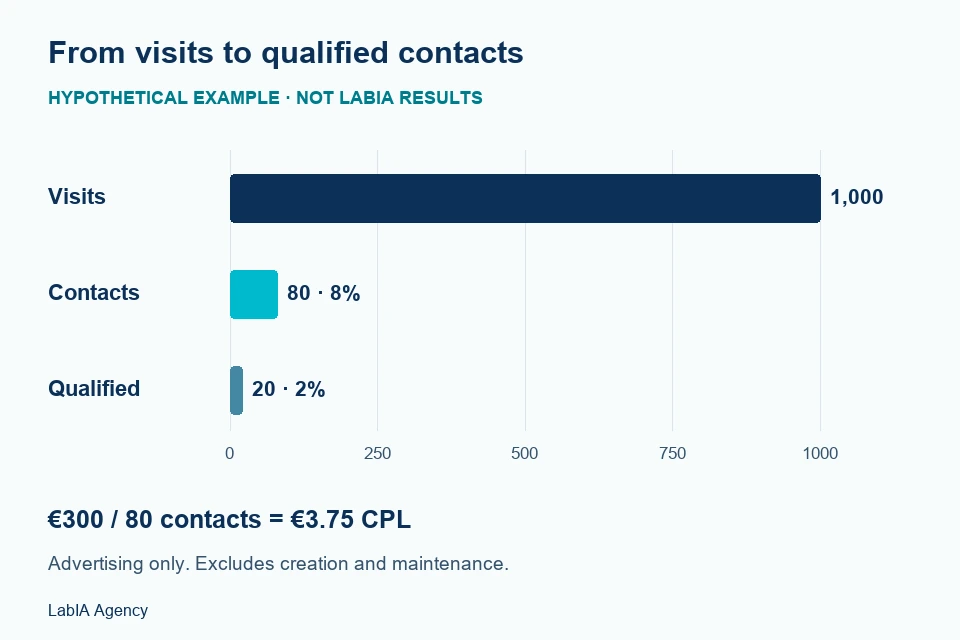
In this case, the 20 qualified contacts represent 25% of the registrations and 2% of the visits. Before measuring them, agree on what qualified means: for example, having a business in the sector, a clearly related need, and a willingness to explore solutions. Don't change that definition later to make the campaign look better. One resource can generate a lot of cheap registrations and few relevant conversations.
Also document what the cost includes. The graph only considers advertising investment; preparing the resource, reviewing texts or maintaining automation consumes additional resources. Compare campaigns with the same cost scope and a consistent time window. If a person comes back multiple times or downloads two resources, avoid counting them as multiple new contacts. The quality of the measurement matters as much as the design of the campaign.
10. Update and test without jumping to conclusions
Review links, examples and usefulness when the context changes. In an A/B test, you define a hypothesis, modify a variable and compare equivalent periods and audiences; don't declare a winner because of a few conversions. Our guide on content automation will help you organize distribution. Tell us what your audience needs to solve: let's start with a useful resource and a relationship worth continuing.