



You close the shop, check Instagram and see a few hearts on your latest post. Yet nobody asks about prices and tomorrow you still have unfilled appointments. If your social media is not attracting customers, posting too little may not be the problem. You may be showing your business without explaining why it is worth a visit. For a small business in Catalonia, the priority is to help people who could realistically visit or contact you.
1. Posting more does not necessarily help people buy
You have been serving people for years and you know how to detect a doubt before the sentence ends. That experience also has value on Instagram and TikTok. But it disappears when your profile looks like a bulletin board: loose offers, photographs without context and messages that could be signed by twenty different businesses.
Social media content that does not convert
- Repeated promotions that do not explain who the product is useful for.
- Videos copied from trends unrelated to your service or your neighborhood.
- Pretty photos without location, practical information or a clear invitation.
- Publications that promise too much and then generate doubts when consulting.
- Generic messages that talk about excellence without showing how you work.
These formats are not automatically a bad choice. An offer can help when it responds to a specific need and its conditions are understood. The problem appears when you post just to tick a box, without thinking about what the person should understand or do next. You don't need to look like a big chain either: your knowledge of the trade can better differentiate you.
2. Turn questions at the counter into useful content
Start with what you hear each week. A workshop can explain when a tire should be checked; a florist, which bouquet withstands the heat better. These are indicative examples, not stories from real clients. In a short video, present a single question, show the answer and end by indicating how to ask about their own situation.
- Write down five questions you are usually asked before buying.
- Choose one and prepare a concrete answer, without waffle or jargon.
- Record a simple demo and check that it looks and sounds good.
- Add checked captions and explain where they can find you.
You don't have to dance or play a character. On Instagram or TikTok you can show your hands at work, explain a decision or honestly compare options. The W3C explains the usefulness of subtitles for people who cannot hear the audio and for situations in which it cannot be heard. Review automatic captions, especially names and words in Catalan.
Use Catalan, Spanish or both depending on how you speak to your clientele, without assuming that everyone prefers the same thing. Keep the language friendly and the instructions understandable. If identifiable customers appear, ask permission before posting; the guidance from the European Consumer Center on images on networks helps to remember this basic care.

3. Make enquiries easier and check what happens next
An interested person can leave if they cannot find an address, hours or how to ask. Review your profile as if you had never entered your business. Do not make them hunt for a hidden phone number or guess if you work by appointment. A simple instruction reduces steps, although it does not guarantee any sales.
- Update location, hours and the contact method that you actually monitor.
- Choose an action per publication: ask for availability or prepare a visit.
- Respond with useful information and confirm the next step without pressure.
- Ask how they heard about you and record inquiries and visits without duplicating them.
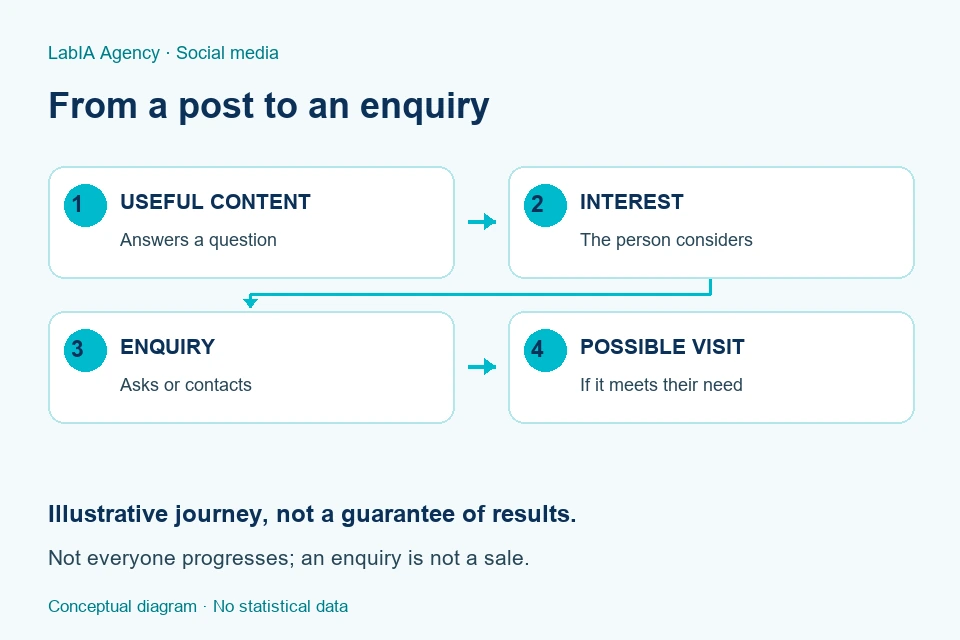
Hearts indicate a reaction, not a purchase. See what questions appear and if people from your area arrive. Compare similar periods and consider holidays, schedules or offer changes. Don't attribute all shop visits to a video because the dates coincide. If you're looking for consistency, our guide on brand tone in short content can help you organize your messages.

Points that help create content that converts
- Resolve a specific question from a person that you can help.
- Show real processes and limits, with easy-to-understand examples.
- Explain location, availability and relevant conditions without hiding information.
- Propose a next step proportionate to the interest of the viewer.
- Review the enquiries received to adjust future topics.
These practices can facilitate decisions, but their scope also depends on the service, price, area and service capacity. They do not compensate for an unclear offer or convert any audience into clientele. They need reasonable continuity and review, not a race to publish daily.
It is also important to distinguish a relevant enquiry from just any message. If you offer an in-person service in Girona, a question from another province may provide conversation, but perhaps not a viable visit. Value the fit without disparaging anyone and clearly explain where you provide service.
Review a sample of your latest posts and look for patterns: topics that raise specific questions, questions that remain unanswered, and people who leave because of missing information. Choose one small change at a time. This way you can learn from what happened without confusing a coincidence with a sure formula to sell more.
4. Conclusions
If your social media is not attracting customers, review the complete journey: what the viewer understands, what builds their trust and how easily they can contact you. Accumulating publications without answering these questions can increase work without bringing you closer to useful enquiries.
Start with a frequently asked question, an honest demonstration and a concrete invitation. Then check the answers and adjust. Set aside time to address enquiries: content opens a conversation that your business needs to be able to continue.
If you need to organize it without improvising every week, request a proposal from LabIA Agency. Tell us what business you have in Catalonia, who you serve and what enquiries or visits you want to facilitate. Let's work on communication that you can sustain, measure and improve.